

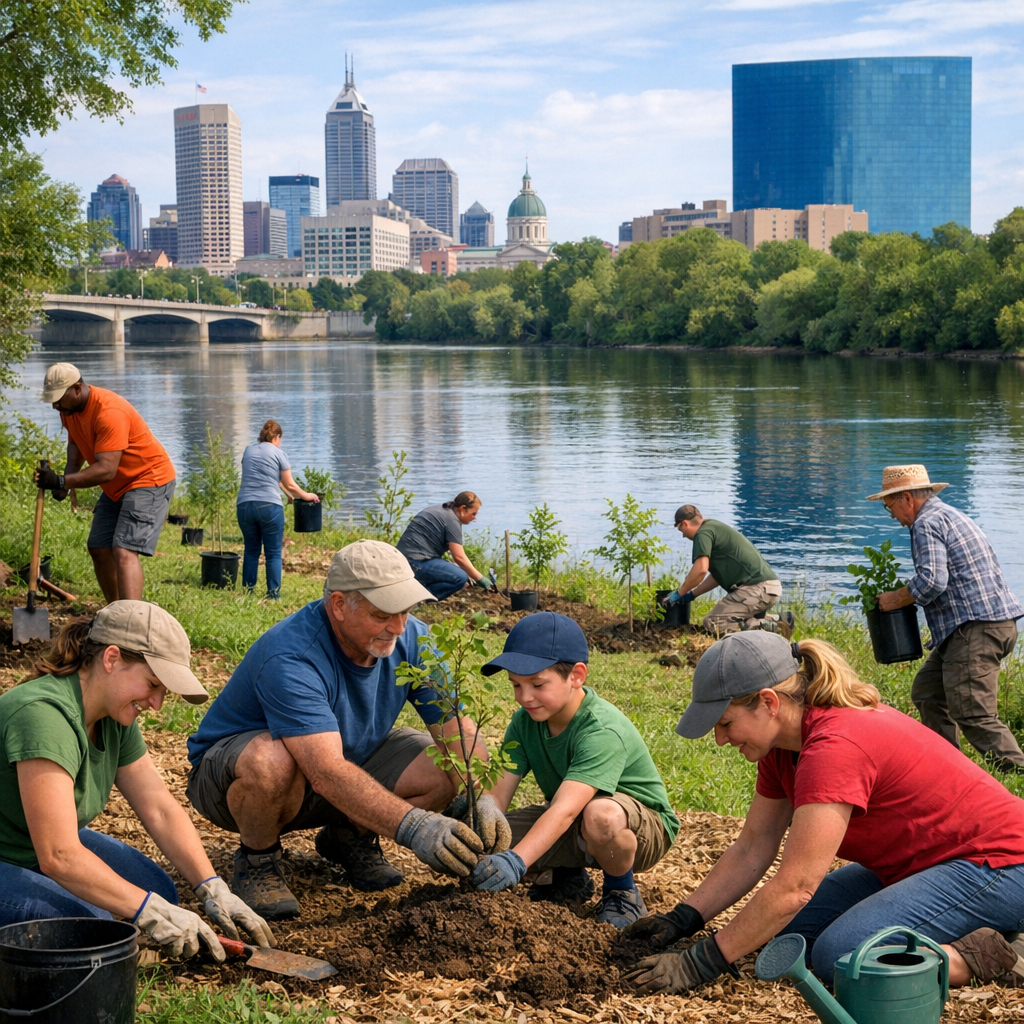
Indianapolis is actively pursuing environmental resilience through various community-driven initiatives, aiming to create a sustainable and equitable future for all residents.
Community-Led Environmental Initiatives
Organizations like Keep Indianapolis Beautiful (KIB) are at the forefront of these efforts. KIB engages diverse communities to create vibrant public spaces by planting trees, building greenspaces, and restoring habitats along the city’s waterways. Their habitat restoration projects focus on removing invasive species and introducing native plants, thereby enhancing biodiversity and stabilizing riverbanks.
Similarly, the Indianapolis Airport Authority (IAA) demonstrates a strong commitment to sustainability. The IAA manages the world’s largest airport-based solar farm, spanning 183 acres and housing 87,478 solar panels. This initiative not only provides renewable energy to the electric grid but also improves air quality and reduces operating costs.
Addressing Environmental Challenges
Despite these positive strides, Indianapolis faces significant environmental challenges. The American Lung Association’s 2026 “State of the Air” report assigned failing grades to Marion County across all air pollution categories—ozone, daily particle pollution, and annual particle pollution. This places the Indianapolis-Carmel-Muncie metropolitan area among the worst nationwide for annual particle pollution, posing serious health risks to residents.
Additionally, the city’s aging stormwater infrastructure is under strain due to increasingly intense storms linked to climate change. The Department of Public Works is implementing new strategies, such as preserving floodplains, to manage stormwater more effectively. However, these efforts underscore the need for substantial investment to enhance the city’s resilience to extreme weather events.
Promoting Environmental Equity
Environmental burdens disproportionately affect communities of color and low-income neighborhoods in Indianapolis. Black households, for instance, face energy burdens 64% higher than the national average. Initiatives like the Solar for All program aim to enhance renewable energy access, lower utility bills, and build resilience in these communities.
Furthermore, the city’s park system has undergone significant improvements, with investments leading to the development of new community centers and the revitalization of existing parks. These enhancements aim to provide equitable access to green spaces, promoting environmental justice and community well-being.
Through collaborative efforts and continued investment, Indianapolis strives to overcome environmental challenges and build a resilient, sustainable future for all its residents.